<   All Posts

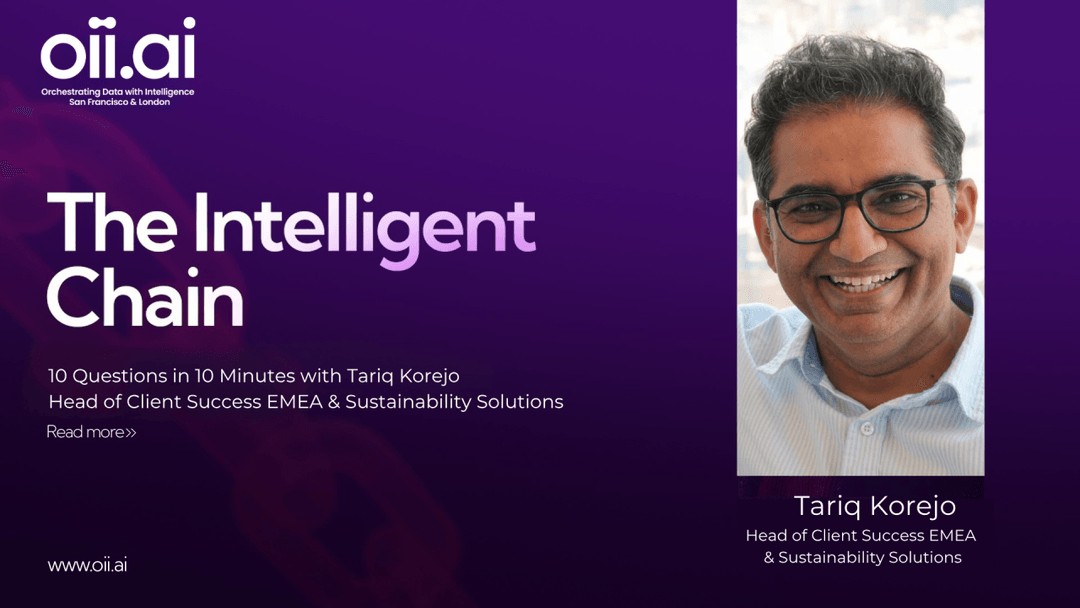
The Intelligent Chain: 10 Questions in 10 Minutes with Tariq Korejo

Written by
Chiara Mantegani
Published on
June 4, 2025
  1. What inspired you to move into sustainability and ESG-focused work?
  2. "I had this notion for some time that business world activity is becoming increasingly detached with the very surrounding in which it operates. We do not consider consciously the costs, short term and long term, that we incur on the very systems that create the enabling environment for business success. The link between impact and business growth / profit is broken.
  3. Separately, I have always been engaged in my spare times volunteering for activities making positive impact on nature and social side of society.
  4. Then over the recent past, climate crisis and sustainability started becoming more than a talking point in corporates and moved into product development in this space. At that point, it was really a no brainer decision to make this transition more formally in my day to do."
  5. What is one mindset or habit from your time at Citi that you still rely on in your role at a fast-paced AI startup?
  6. "Being creative yet structured. Start with client pain point but do not be limited by it. Solve for big problems but be open to possibility of discovering new value adds and hitting jackpots. While doing this, always keep a framework handy that presents your proposition like a story easily to tell and understand."
  7. You have navigated both fintech innovation and corporate banking. What is the biggest cultural difference between the two worlds?
  8. "Speed of Decision Making about new initiatives. It is faster in fintech and is tied to the appetite for experimenting, higher level of urgency, less people involved in making that decision and incentives supporting new ideas and execution."
  9. What is one underrated skill that has helped you succeed across finance, tech, and sustainability?
  10. "Pattern recognition and asking right questions. With more data available to us, we must be able to ask better questions to get us to the level of intelligence that does not merely meets our requirement but adds a WoW factor due to its novelty, richness and value. Our ability to connect dots between processes and activities allows us to be more imaginative and ask better questions."
  11. If you could go back and give your younger self one piece of career advice, what would it be?
  12. "Network of Mentors. Make conscious effort to find great mentors at every stage of your career, nurture your relationships with them and actively seek their insights. It will surprise you how deep and long term an impact they can have on your trajectory."
  13. What is one thing clients always underestimate about implementing AI in supply chains?
  14. "Internal communication. Successful AI application in business supply chain tends to be an intensely collaborative effort across business lines, departments, geographies. Even departmental objectives can vary from one to another.
  15. Having clear communication on the purpose and implementation of journey along with roles, responsibilities, team objectives, individual objectives and rewards is critical and yet not obvious at the start in many cases."
  16. What is the biggest challenge companies face in turning sustainability goals into measurable business value?
  17. "Lack of readily available, relevant and credible data and widely accepted benchmarks is the biggest challenge. If we have more of that, it will make it easier to build cases for approvals internally as we would be able to demonstrate clearly a measurable value. That will make ROI related discussion easier which are challenging sometime for sustainability initiatives."
  18. What is one sustainability question companies should be asking about their supply chains but usually don’t?
  19. "Is there a merit in collaborating with competition in certain geographies or business lines? For example, what if joining hands with peer companies help transform suppliers faster in a certain geography. It can potentially open possibilities of better funding opportunities for suppliers and new sustainable infrastructure in specific markets."
  20. In five years, what is something companies will expect from AI-powered supply chains that they don’t even think about today?
  21. "Pervasive use of outward facing supply chain AI agents managing complex decisions on the go in the face of more frequent disruptions. Companies would expect that entire end of end of supply chains (from raw material to the last mile consumer) will be operating in a way that any change in one place will quickly enable a decision for change at the other end.
  22. This is a lot of complexity that is handled in a more reactive and time-consuming way today and ability of AI agents and more cyber secure arrangements will enable systems of different supply chain participants talk to each other in a smooth flow."
  23. If you could invite anyone, dead or alive to a private dinner party, who would it be?
  24. "Nelson Mandela. In these more disruptive times, more than ever before, we need inspiration from icons that led transformative change with sheer focus and conviction of purpose."

News
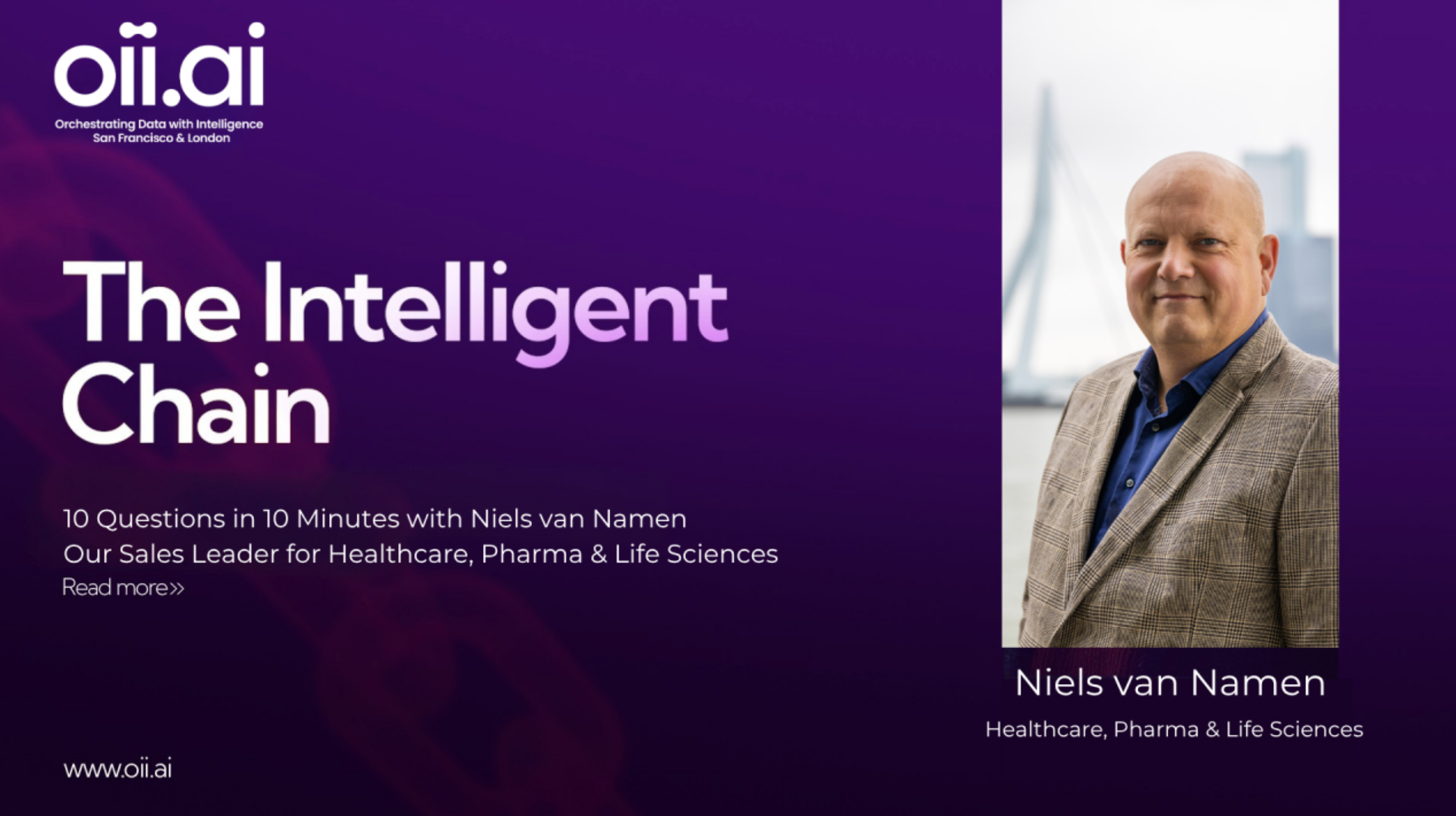
The intelligent chain 10 questions in 10 minutes Niels van Naman our sales leader for Healthcare,Pharma & Life Sciences
10 Questions in 10 Minutes with Niels van Namen! Welcome to Oii.ai, Niels!We are excited to welcome Niels van Namen as our Sales Leader for Healthcare, Pharma and Life Sciences at Oii.ai. Niels brings extensive experience from leadership roles at IBM, UPS and DSV, with deep expertise in healthcare logistics, pharma supply chains and strategic transformation. His background spans engineering, consulting and global business development. Now he is helping our customers use AI to make smarter and faster supply chain decisions.Get to know Niels in this quick fire interview where he shares career insights, industry perspectives and thoughts on leadership and innovation.
Bob Rogers
August 30, 2025
News
Voices from Oii.ai: Episode Two
How do businesses stay ahead in a world of constant change? One answer is the digital twin. In this episode we explore how a digital twin is built, what it does and how it helps businesses make better strategic choices. By creating a continuous loop of optimisation, it frees up human experts to focus on decisions that matter most, guided by clear, real time insights. Stay tuned to hear how Oii.ai is helping organisations use digital twins to stay ahead.
Bob Rogers
September 1, 2025
News
The intelligent chain 10 questions in 10 minutes with Moshe Wolfson Head of Sales
We are thrilled to welcome Moshe as Sales Head – Europe. 👏 Moshe Marvin Wolfson brings years of experience in software and digital solutions, with a strong record of driving growth, building client trust, and closing deals of all sizes. He has held senior roles at a trade finance fintech start up and Surecomp where he led global sales and implementation teams to great success. To celebrate his arrival, Moshe joined our “Intelligent Chain: 10 Questions in 10 Minutes” series where he shares his thoughts on sales, leadership, risk taking and more. Check out the interview below to get to know Moshe. Welcome to the team, we are excited to have you on board!! The Intelligent Chain: 10 Questions in 10 Minutes With Moshe Wolfson What inspired you to pursue a career in technology? "When I began university, I studied Mathematics with Computer Science as a minor. It was still a new subject, but I could see it had the potential to be a real game changer. We studied the abstract Turing machine, not realising at the time that Alan Turing was the man who broke the Enigma code. Later, when I watched the movie, The Imitation Game, I came to appreciate how revolutionary his work was. Over the past eight years, that same sense of inspiration has led me into the world of AI and digitisation."
Bob Rogers
September 8, 2025

Oii.ai enables organisations to consistently achieve the perfect supply chain planning set up to meet their strategic goals and maximise profit.

Contact

info@oii.ai